🔍 Data Flagging Results
Comprehensive Analysis of Flagged Vehicles in OBFCM
2021-2023 Dataset
🔍 Flagged Vehicles Pattern Analysis
📅 Date: December 24, 2024
📊 Dataset: OBFCM 2021-2023 PHEV data
Original dataset: 7,732,320 records; PHEV subset: 995,511 records
🎯 Analysis Focus: Identifying patterns, correlations, and interesting connections in flagged vehicles
📑 Table of Contents
📋 Executive Summary
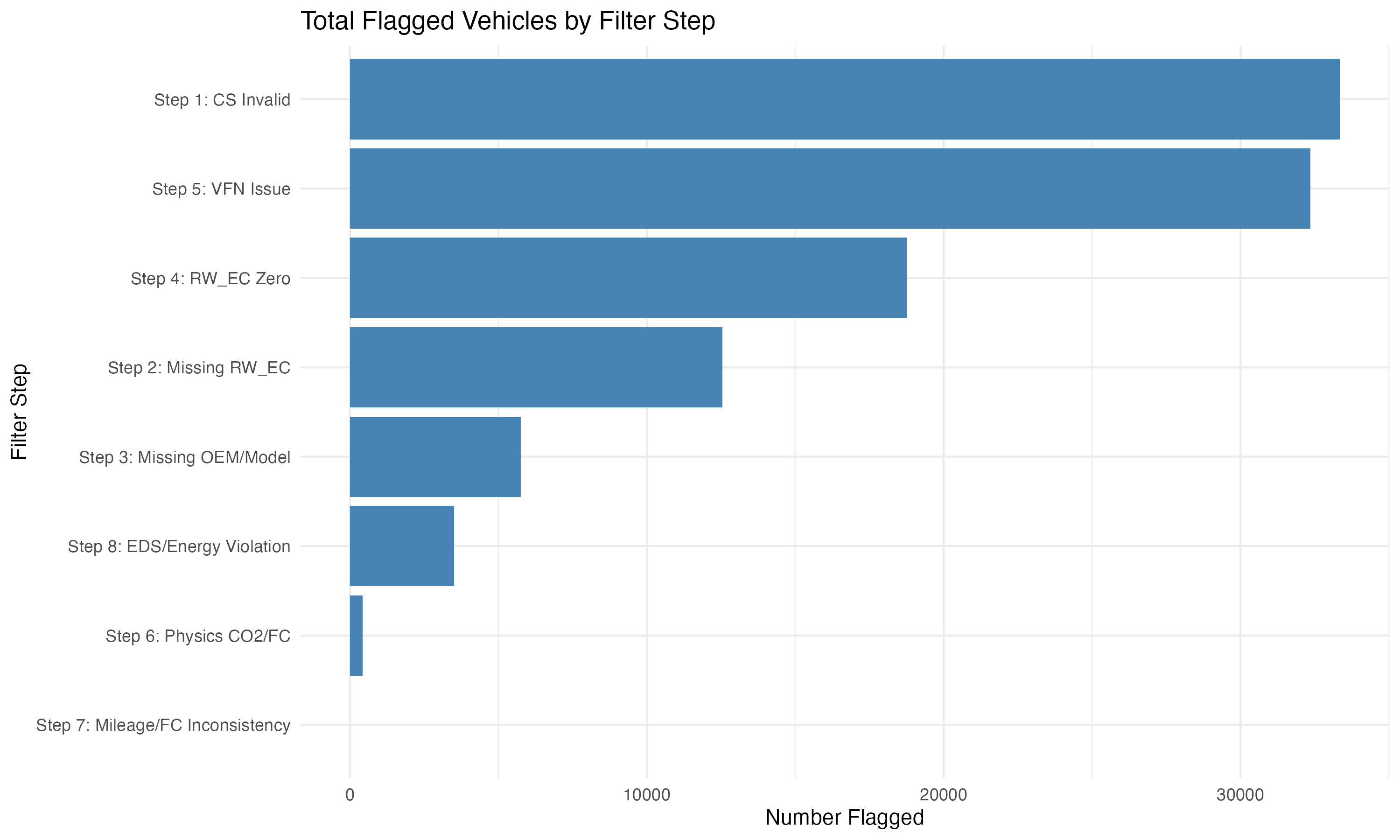
Analysis of flagged vehicles reveals several significant patterns:
| Filter Step | Vehicles Flagged | Key Finding |
|---|---|---|
| Step 1 (CS Invalid) | 33,348 | Dominated by Stellantis group vehicles (Fiat, Jeep, Opel) and Mitsubishi Eclipse Cross |
| Step 2 (Missing RW_EC) | 12,554 | Strongly associated with Hyundai models (Tucson, Santa Fe) and Ford vehicles |
| Step 4 (RW_EC Zero) | 18,779 | Heavily dominated by Porsche Panamera and Cayenne E-Hybrid models |
| Step 3 (Missing OEM/Model) | 5,753 | Vehicles with missing manufacturer or model information |
| Step 5 (VFN Issue) | 32,363 | Volvo/Polestar models and Geely vehicles overrepresented |
| Step 6 (Physics CO2/FC) | 420 | Physically implausible CO₂ or fuel consumption values |
| Step 7 (Mileage/FC Inconsistency) | 565 | Logical impossibilities in mileage and fuel consumption |
| Step 8 (EDS/Energy Violation) | 3,506 | EDS or energy values outside acceptable ranges |
Key Insights
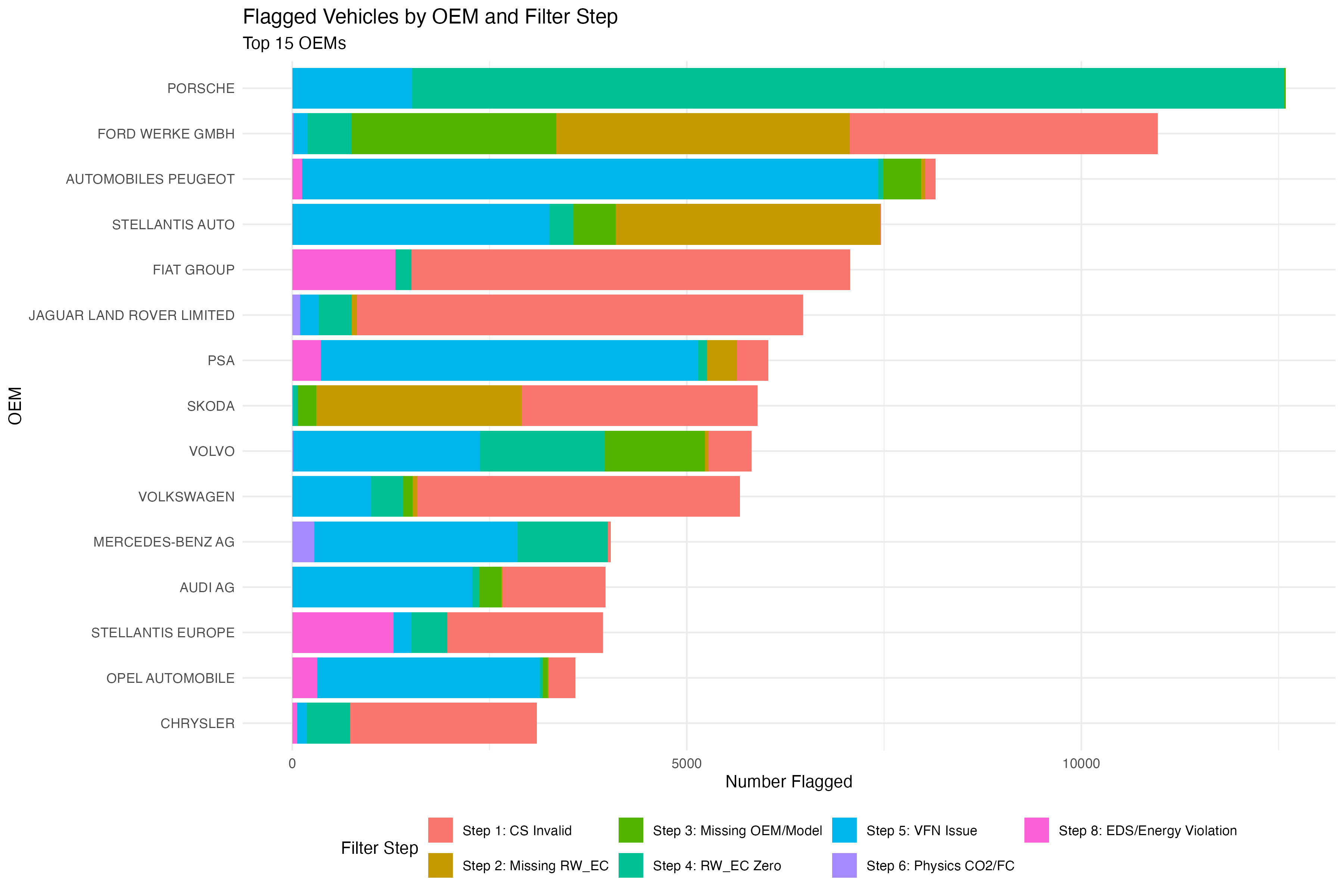
- Manufacturer Patterns - Stellantis group shows consistent data quality issues across multiple steps
- Vehicle Characteristics - Flagged vehicles show systematic differences in mass, engine power, and electric range
- Model-Specific Issues - Certain models (Porsche Panamera, Hyundai Tucson, Mitsubishi Eclipse Cross) show extreme overrepresentation
- Data Quality Concerns - Patterns suggest both genuine vehicle characteristics and potential data reporting issues
📊 Detailed Findings by Filter Step
🔴 Step 1: CS Invalid (33,348 vehicles flagged)
What it means: Vehicles with invalid Charge-Sustaining (CS) mode data
Top Manufacturers
| Manufacturer | Vehicles Flagged | Percentage of Flagged | Overrepresentation |
|---|---|---|---|
| Jaguar Land Rover Limited | 5,654 | 16.95% | - |
| Fiat Group | 5,561 | 16.68% | - |
| Volkswagen | 4,091 | 12.27% | - |
| Ford Werke GmbH | 3,903 | 11.70% | - |
| Skoda | 2,991 | 8.97% | - |
Top Models (by Overrepresentation)
| Model | Overrepresentation |
|---|---|
| Mitsubishi Eclipse Cross | 19,345% ⚠️ |
| Volkswagen Passat | 10,020% ⚠️ |
| Jaguar E-PACE P300E R-Dynamic | 9,502% ⚠️ |
| Opel Grandland X | 8,542% ⚠️ |
Vehicle Characteristics Comparison
| Characteristic | Flagged Vehicles | Clean Vehicles | Difference | Direction |
|---|---|---|---|---|
| Mass | 2,060 kg | 2,121 kg | -2.89% | ⬇️ Lighter |
| TA_CO₂ | 37.4 g/km | 35.2 g/km | +6.10% | ⬆️ Higher |
| Electric Range | 77.5 km | 63.3 km | +22.32% | ⬆️ Longer |
| Engine Displacement | 1,642 cc | 1,863 cc | -11.84% | ⬇️ Smaller |
| Engine Power | 123 kW | 141 kW | -12.92% | ⬇️ Lower |
| Total Mileage | 19,807 km | 26,443 km | -25.10% | ⬇️ Lower |
💡 Key Insight
Vehicles flagged in Step 1 tend to be lighter and have smaller engines, but paradoxically show higher CO₂ emissions and longer electric range. This suggests potential issues with: - Charge-sustaining mode operation - Data reporting in these specific models - Possible calibration or sensor issues
🌐 Online Research Context
- Jeep/Chrysler: Research shows these brands have high complaint rates (1,488 complaints per car for Jeep) and recall rates (1.06 for Jeep/Chrysler), suggesting broader quality control issues that may extend to data reporting.
- Mitsubishi Eclipse Cross PHEV: Limited specific information found, but the extreme overrepresentation suggests model-specific issues with CS mode data collection or reporting.
🟠 Step 2: Missing RW_EC (12,554 vehicles flagged)
What it means: Vehicles missing Real-World Electric Consumption (RW_EC) data
Top Manufacturers
| Manufacturer | Vehicles Flagged | Percentage of Flagged |
|---|---|---|
| Ford Werke GmbH | 3,720 | 29.63% |
| Stellantis Auto | 3,352 | 26.70% |
| Skoda | 2,603 | 20.73% |
| BMW AG | 597 | 4.76% |
| Hyundai Czech | 590 | 4.70% |
Top Models (by Overrepresentation)
| Model | Overrepresentation |
|---|---|
| Hyundai Tucson/Tucson IX35 | 216,430% ⚠️⚠️ |
| Hyundai Santa Fe | 110,157% ⚠️⚠️ |
Vehicle Characteristics Comparison
| Characteristic | Flagged Vehicles | Clean Vehicles | Difference | Direction |
|---|---|---|---|---|
| Mass | 1,926 kg | 2,122 kg | -9.21% | ⬇️ Lighter |
| TA_CO₂ | 28.9 g/km | 35.4 g/km | -18.20% | ⬇️ Lower |
| Engine Power | 120 kW | 141 kW | -14.85% | ⬇️ Lower |
| Total Mileage | 18,907 km | 26,314 km | -28.15% | ⬇️ Lower |
| FC_Tot (Total Fuel Consumption) | 1,011 L | 1,610 L | -37.18% | ⬇️ Lower |
💡 Key Insight
Missing RW_EC is strongly associated with Hyundai models (Tucson, Santa Fe) and Ford vehicles. These vehicles tend to be: - Lighter than average - Have lower emissions - Have lower total fuel consumption - May be newer models or have different monitoring systems
🌐 Online Research Context
- Hyundai/Kia: Recent recalls affecting millions of vehicles, though not specifically related to PHEV data reporting. The extreme overrepresentation of Hyundai models suggests potential issues with their OBFCM implementation or data transmission.
🟡 Step 3: Missing OEM/Model (5,753 vehicles flagged)
What it means: Vehicles with missing manufacturer or model information
Top Manufacturers
| Manufacturer | Vehicles Flagged | Percentage of Flagged |
|---|---|---|
| Volvo | 1,270 | 22.06% |
| Peugeot | 461 | 8.00% |
| Missing (NA) | 449 | 7.80% |
| Audi | 224 | 3.89% |
| SEAT | 117 | 2.03% |
💡 Key Insight
Step 3 flags vehicles with missing OEM or Model information. This is a data quality issue that affects vehicle identification and analysis. Volvo vehicles show the highest number of missing information cases, followed by Peugeot.
🔵 Step 4: RW_EC Zero (18,779 vehicles flagged)
What it means: Vehicles reporting zero Real-World Electric Consumption (indicating no electric mode usage)
Top Manufacturers (by Overrepresentation)
| Manufacturer | Overrepresentation |
|---|---|
| Porsche | 225,325% ⚠️⚠️⚠️ |
| Ferrari | 420% |
| Suzuki | 378% |
Top Models (by Overrepresentation)
| Model | Overrepresentation |
|---|---|
| Porsche Panamera 4S E-Hybrid | 4,426,839% ⚠️⚠️⚠️ |
| Porsche Panamera 4 E-Hybrid | 2,691,396% ⚠️⚠️⚠️ |
| Porsche Panamera 4 | 1,187,172% ⚠️⚠️⚠️ |
| Porsche Cayenne E-Hybrid | 164,224% ⚠️⚠️ |
Vehicle Characteristics Comparison
| Characteristic | Flagged Vehicles | Clean Vehicles | Difference | Direction |
|---|---|---|---|---|
| Mass | 2,350 kg | 2,115 kg | +11.11% | ⬆️ Heavier |
| TA_CO₂ | 57.3 g/km | 34.9 g/km | +64.36% | ⬆️ Much Higher |
| Electric Range | 53.3 km | 64.0 km | -16.75% | ⬇️ Shorter |
| Engine Displacement | 2,513 cc | 1,842 cc | +36.39% | ⬆️ Much Larger |
| Engine Power | 213 kW | 139 kW | +52.74% | ⬆️ Much Higher |
| FC_Tot (Total Fuel Consumption) | 2,198 L | 1,591 L | +38.20% | ⬆️ Higher |
💡 Key Insight
This is the most striking pattern - Porsche luxury PHEVs (Panamera, Cayenne) are reporting zero electric consumption. These are: - High-performance vehicles - Heavy vehicles (2,350 kg average) - Large engines (2,513 cc average) - High power (213 kW average)
Possible explanations for zero RW_EC: 1. 🔋 Battery issues preventing electric mode operation 2. 🚗 Driver behavior (not charging vehicles) 3. 📊 Data reporting problems specific to Porsche’s OBFCM implementation 4. ⚙️ Design issues where electric mode is rarely engaged
🟣 Step 5: VFN Issue (32,363 vehicles flagged)
What it means: Vehicle Family Name (VFN) validation failures
Top Manufacturers (by Overrepresentation)
| Manufacturer | Overrepresentation |
|---|---|
| Geely | 529,641% ⚠️⚠️⚠️ |
| Ferrari | 3,379% |
| Opel Automobile | 1,619% |
Top Models (by
Overrepres
🟢 Step 6: Physics CO2/FC (420 vehicles flagged)
What it means: Vehicles with physically implausible CO₂ or fuel consumption values
Criteria: FCgap_perc > 1800 OR TA_CO2 >= 190 OR RW_CO2 > 800
Top Manufacturers
| Manufacturer | Vehicles Flagged | Percentage of Flagged |
|---|---|---|
| Mercedes-Benz | 280 | 66.67% |
| Land Rover | 99 | 23.57% |
| Ferrari | 14 | 3.33% |
| BMW | 8 | 1.90% |
| Volvo | 6 | 1.43% |
💡 Key Insight
Step 6 flags vehicles with physically impossible values, suggesting data reporting errors or sensor malfunctions. Mercedes-Benz vehicles, particularly GLC models, show the highest incidence of physics violations.
🟠 Step 7: Mileage/FC Inconsistency (565 vehicles flagged)
What it means: Vehicles with inconsistent mileage and fuel consumption relationships
Criteria: Logical impossibilities such as fuel consumption without distance, or large distance with zero fuel
Breakdown by Inconsistency Type
| Inconsistency Type | Vehicles Flagged |
|---|---|
| CD engine-on (mileage=0, FC>0.1) | 196 |
| CS zero distance (mileage=0, FC>0.1) | 27 |
| CI zero distance (mileage=0, FC>3) | 359 |
| CS large distance, zero fuel (mileage>100, FC=0) | 6 |
💡 Key Insight
Step 7 identifies logical impossibilities in the data, such as reporting fuel consumption without corresponding distance traveled. These inconsistencies suggest data collection or reporting errors.
🔵 Step 8: EDS/Energy Violation (3,506 vehicles flagged)
What it means: Vehicles with EDS or energy values outside acceptable ranges
Criteria: EDS outside 0-100%, negative energy values, or energy accounting inconsistencies
Breakdown by Violation Type
| Violation Type | Vehicles Flagged |
|---|---|
| EDS bounds violations (outside 0-100%) | 4,396 |
| Negative energy values | 0 |
| Energy identity violations | 0 |
Top Manufacturers
| Manufacturer | Vehicles Flagged | Percentage of Flagged |
|---|---|---|
| Missing (NA) | 21,395 | 85.12% |
| Jeep | 3,210 | 12.77% |
| Opel | 322 | 1.28% |
| Peugeot | 300 | 1.19% |
| Volvo | 245 | 0.97% |
💡 Key Insight
Step 8 flags vehicles with EDS values outside the physically possible range of 0-100%. Most violations occur in vehicles with missing OEM information, suggesting data quality issues in identification and reporting.
entation)
| Model | Overrepresentation |
|---|---|
| Volvo V60 T6 Twin Engine | 133,677% ⚠️⚠️ |
| Polestar 1 | 111,381% ⚠️⚠️ |
| Volvo XC90 T8 Twin Engine | 92,057% ⚠️⚠️ |
💡 Key Insight
VFN issues are primarily with: - Volvo/Polestar models (owned by Geely) - Other Geely-owned brands
This suggests: - VFN whitelist may need updating - Naming inconsistencies in Geely’s reporting - Corporate structure changes affecting data standardization
🌐 Online Research Context
- Geely-Volvo Relationship: Geely acquired Volvo Cars in 2010, explaining VFN naming inconsistencies between different reporting systems.
🔗
📊 Flag Combination Visualizations
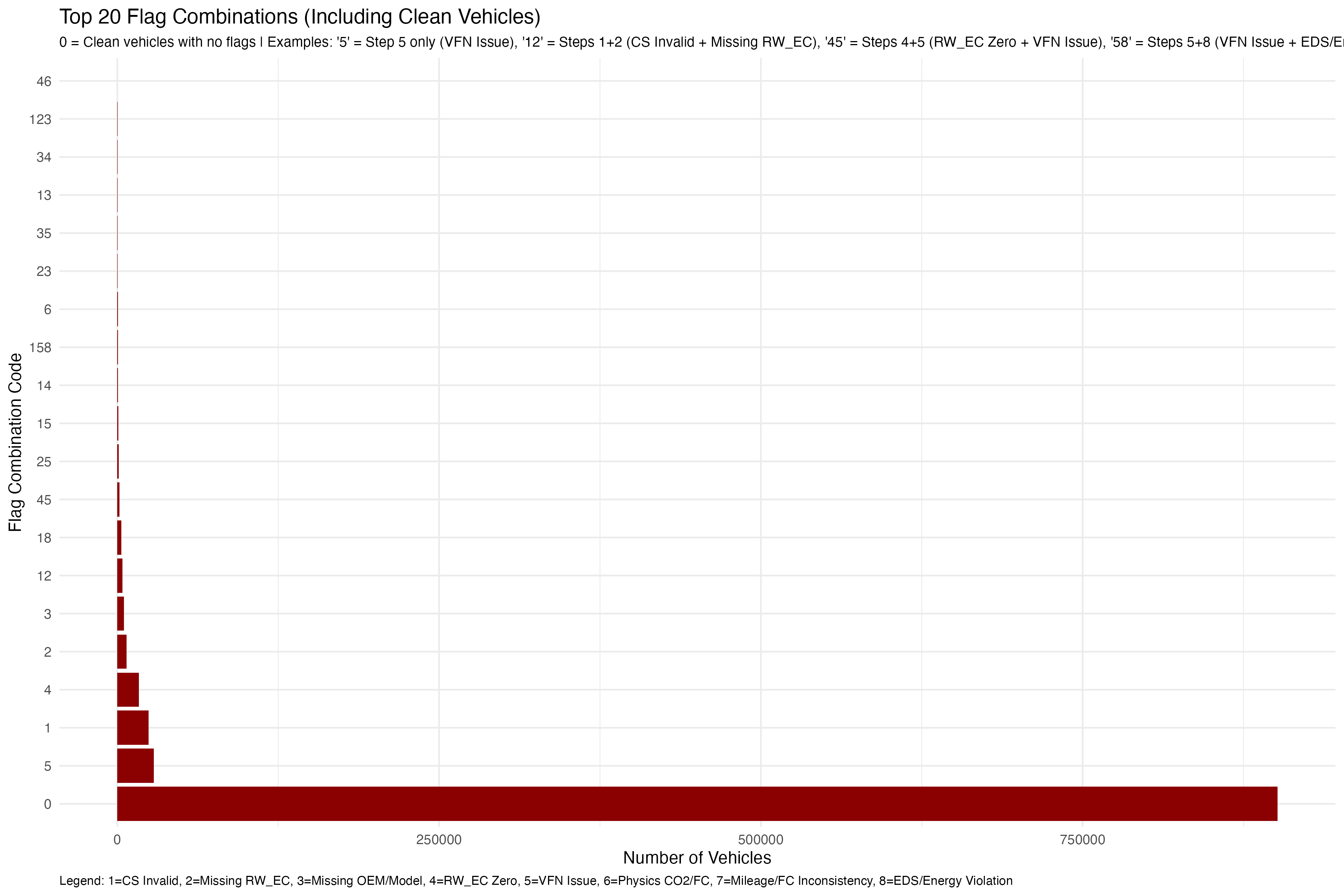
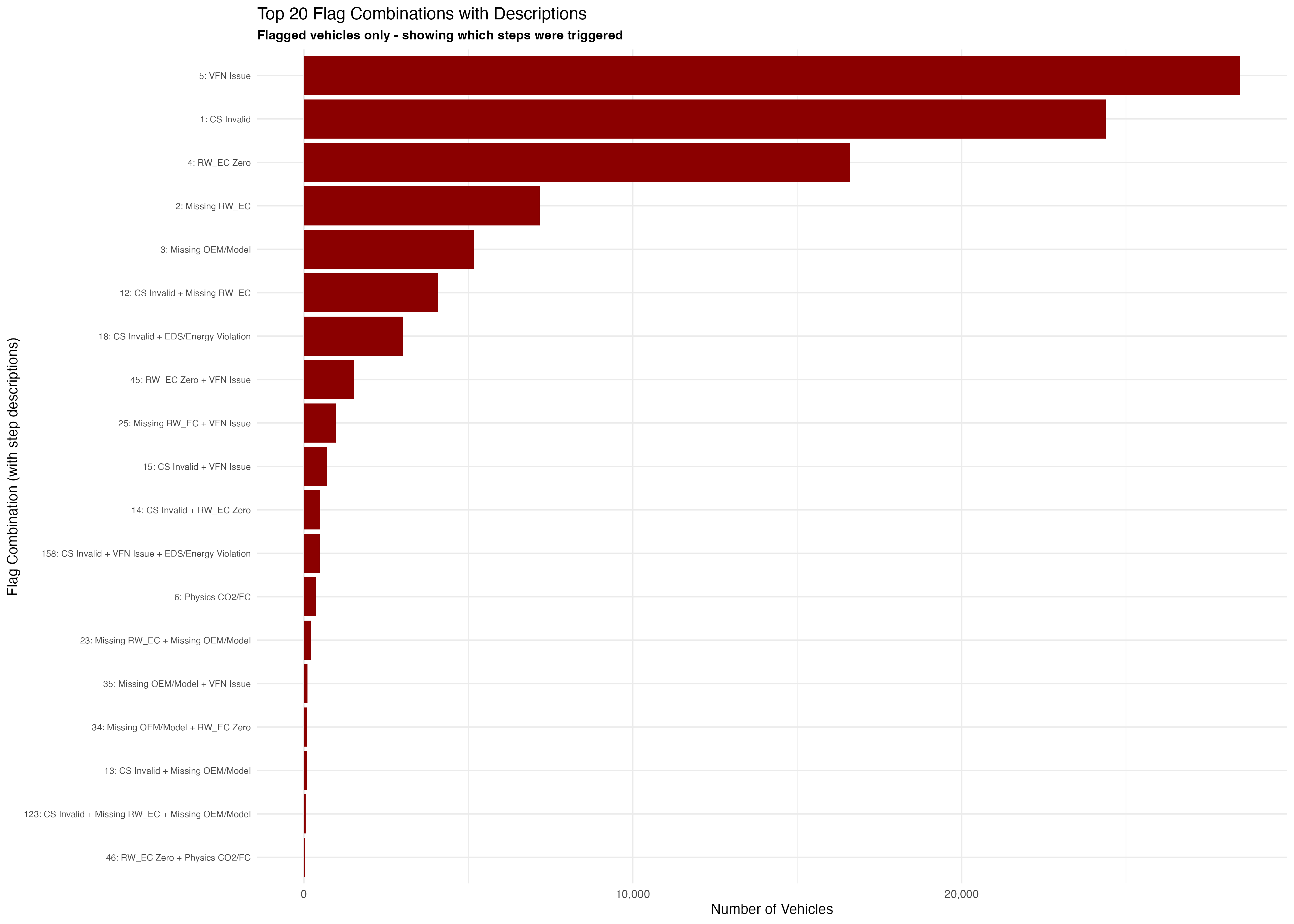
The following figures show the distribution of flag combinations across all vehicles. Flag codes represent which filtering steps were triggered:
- 1 = CS Invalid, 2 = Missing RW_EC, 3 = Missing OEM/Model, 4 = RW_EC Zero
- 5 = VFN Issue, 6 = Physics CO2/FC, 7 = Mileage/FC Inconsistency, 8 = EDS/Energy Violation
- 0 = Clean vehicles with no flags
How combinations work: Multi-digit codes combine steps. Examples: '5' = Step 5 only (VFN Issue), '12' = Steps 1+2 (CS Invalid + Missing RW_EC), '45' = Steps 4+5 (RW_EC Zero + VFN Issue), '58' = Steps 5+8 (VFN Issue + EDS/Energy Violation)
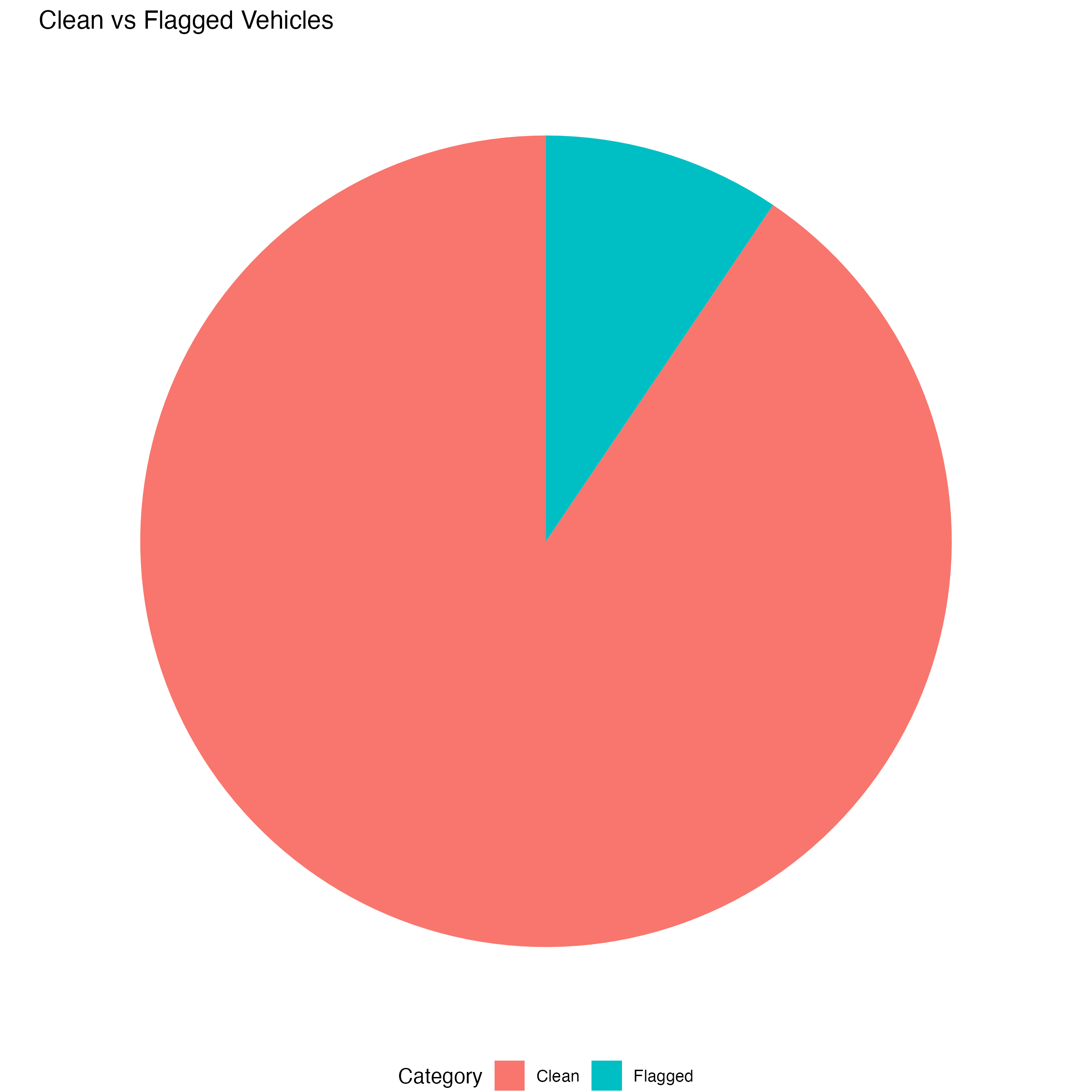
Cross-Step Patterns
🏢 Stellantis Group (Fiat, Opel, Peugeot, Chrysler, Jeep)
Consistent Issues Across Multiple Steps:
| Filter Step | Issue Type | Affected Brands |
|---|---|---|
| Step 1 | CS Invalid | Fiat, Opel, Jeep |
| Step 2 | Missing RW_EC | Stellantis Auto |
| Step 3 | Missing OEM/Model | Stellantis Auto, Peugeot |
| Step 8 | EDS/Energy Violation | Stellantis Europe, Fiat, Opel, PSA |
Analysis
The consistent data quality issues across Stellantis brands suggest:
- Common OBFCM implementation across brands
- Shared data reporting infrastructure
- Potential systemic issues in their PHEV monitoring systems
🌐 Online Research Context
- Stellantis Formation: Stellantis was formed in 2021 from the merger of FCA (Fiat Chrysler Automobiles) and PSA (Peugeot Société Anonyme)
- The merger may have created integration challenges in data reporting systems
📚 References
Online Research Sources
- Jeep/Chrysler Quality Issues:
- Carscoops: Volvo, Subaru, Tesla Lead Study with Most 5-Star Safety Ratings
- Jeep: 1,488 complaints per car, recall rate of 1.06
- Hyundai/Kia Recalls:
- Automotive Recall Statistics:
- AutoInsurance.com: Car Recall Facts & Statistics
- Ford: 94 recalls affecting 5.6M vehicles (2024-2025)
- Tesla: 20 recalls affecting 5.8M vehicles
- Stellantis Formation:
- Stellantis formed in 2021 from merger of FCA (Fiat Chrysler Automobiles) and PSA (Peugeot Société Anonyme)
- Geely-Volvo Relationship:
- Geely acquired Volvo Cars in 2010, explaining VFN naming inconsistencies
Data Sources
- OBFCM dataset analysis (2021-2023)
- Pattern analysis using statistical tests (t-tests, overrepresentation analysis)
- Internal flagging statistics from cleaning pipeline
📌 Important Notes
⚠️ Disclaimer: This analysis is based on OBFCM data from 2021-2023. Patterns may reflect both genuine vehicle characteristics and data quality issues. Further investigation with manufacturers is recommended for flagged models.
Recommendations
- Contact manufacturers for flagged models to verify data reporting accuracy
- Update VFN whitelist to include Geely/Volvo naming variations
- Investigate Porsche OBFCM implementation for zero RW_EC reporting
- Review Stellantis data pipeline for systemic issues
- Monitor Hyundai models for missing RW_EC data in future datasets
Document Version: 1.0
Last Updated: December 24, 2024
Author: Data Analysis Team